
Teaching Emotional Regulation in Preschool: Practical Strategies for Educators
Seven simple, research-informed classroom activities to help young children recognize feelings, practice coping strategies, and build meaningful connections.
It's 9:15 in the morning. One child is crying because another took their favorite toy. A second child refuses to join circle time. Across the classroom, someone is struggling to wait for a turn.
For preschool educators, moments like these are part of everyday teaching.
They can also become opportunities to help children develop emotional regulation— the gradually developing ability to recognize feelings, navigate emotional experiences, and respond to situations with increasing flexibility.
But emotional regulation doesn't begin with expecting a preschooler to calm down independently.
It begins with relationships, supportive routines, and repeated opportunities to practice skills.
What Is Emotional Regulation in Preschool?
Emotional regulation refers to the developing processes that help children navigate emotional experiences and adjust their responses to different situations.
A child who is developing emotional regulation may gradually learn to:
- Recognize when they are becoming frustrated.
- Use words or visual supports to communicate a feeling.
- Ask an adult for help.
- Try a familiar calming strategy.
- Return to an activity after a difficult moment.
These abilities are developing throughout early childhood and vary among individual children.
The Collaborative for Academic, Social, and Emotional Learning (CASEL) identifies self-awareness and self-management among the core competencies of social-emotional learning.
These competencies include recognizing emotions and developing the ability to manage behavior, feelings, and responses in different situations.
For additional background on recognizing and naming emotions, explore our first article: Why Emotional Literacy Matters in Early Childhood .
Emotional regulation does not mean remaining quiet, following every instruction, or hiding difficult emotions.
A child can be angry, sad, or frustrated and still be learning healthy ways to express those feelings.
Why Co-Regulation Comes Before Self-Regulation
Preschool children are still developing the abilities needed to manage strong emotions independently.
They often depend on attentive adults to help them navigate frustration, disappointment, fear, and overstimulation.
This supportive process is called co-regulation.
Co-regulation may include a calm voice, predictable routines, appropriate physical proximity, clear boundaries, and support in finding the next step.
Research-Informed Practice
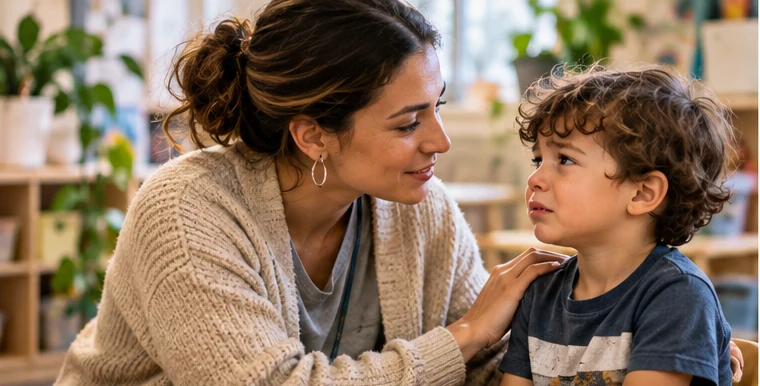
The National Association for the Education of Young Children (NAEYC) describes classroom strategies that help children notice their body states, identify feelings, and explore ways to regulate their emotional experiences.
These approaches include emotional check-ins, adult-supported comfort spaces, and meaningful conversations.
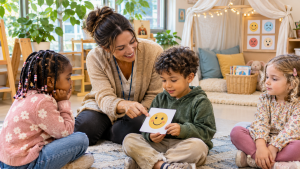
What Co-Regulation Looks Like in Practice
The goal is not immediate compliance or an instant change in mood.
It is to support a child through an emotionally demanding moment.
7 Emotional Regulation Activities for Preschoolers
These activities are designed for daily classroom routines and can be adapted for children with different communication, sensory, and developmental needs.
Each activity introduces or practices a component of emotional learning. No single activity will regulate every child in every situation.
1. The Morning Feelings Check-In
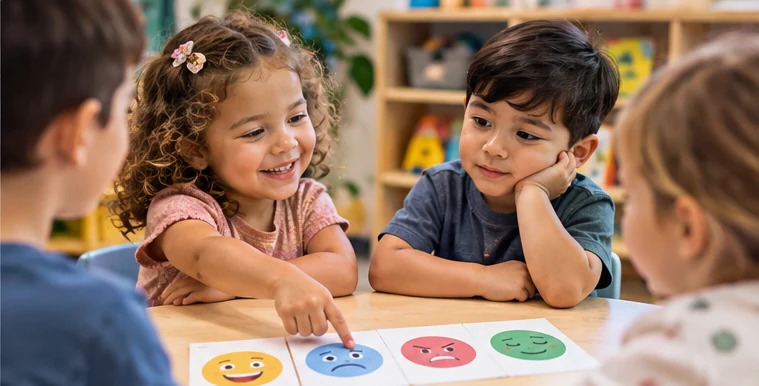
Begin the day by inviting children to identify how they feel.
Present a few accessible choices such as happy, sad, angry, worried, or calm.
"¿Cómo te sientes hoy?"
Children may respond by pointing, speaking, using a communication device, or choosing not to answer.
2. The Feelings Detective Game
Show a picture of a character experiencing an emotion.
Ask children to notice facial expressions, body language, and the situation.
"How might this character feel?"
"What could help them?"
Encourage several possible interpretations instead of expecting one correct answer.
3. Breathe With a Pretend Balloon
Invite children to imagine holding a small balloon between their hands.
Encourage a comfortable, gentle breath in, followed by a relaxed breath out as they slowly move their hands apart.
Keep it playful and optional. Some children may prefer another calming activity.
4. Move, Pause, and Freeze
Invite children to move in place using simple actions such as marching, waving, or dancing.
Say "Freeze!" and encourage children to pause their movements.
Alternate between moving and stopping.
"¡Muévete... y quieto!"
These playful stop-and-go activities provide opportunities to practice attention and inhibitory control.
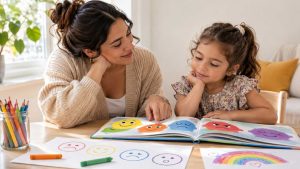
5. Draw Your Feelings
Invite children to represent a feeling through colors, lines, shapes, or characters.
They can draw what makes them happy, imagine an angry monster, or create a quiet place.
Let children choose their own colors and explanations.
For a guided starting point, explore the bilingual Emotional Explorers at The Mananas Studio .
6. What Could Our Character Do?
Introduce a simple fictional classroom situation.
For example, a character feels angry because another child took their toy.
Explore safe responses: asking for help, speaking to a friend, taking a pause, or trying again.
Allow children to act out possible solutions using puppets or other materials.
7. Create a Classroom Calm Plan
Invite children to explore different calming options.
- Ask an adult for help.
- Spend time in a quiet area.
- Look at a favorite book.
- Try a gentle breathing activity.
- Use an appropriate sensory tool.
Children can select one or two strategies they may want to try.
Display the options in a simple visual format.
How to Create a Calm Corner in Your Preschool Classroom
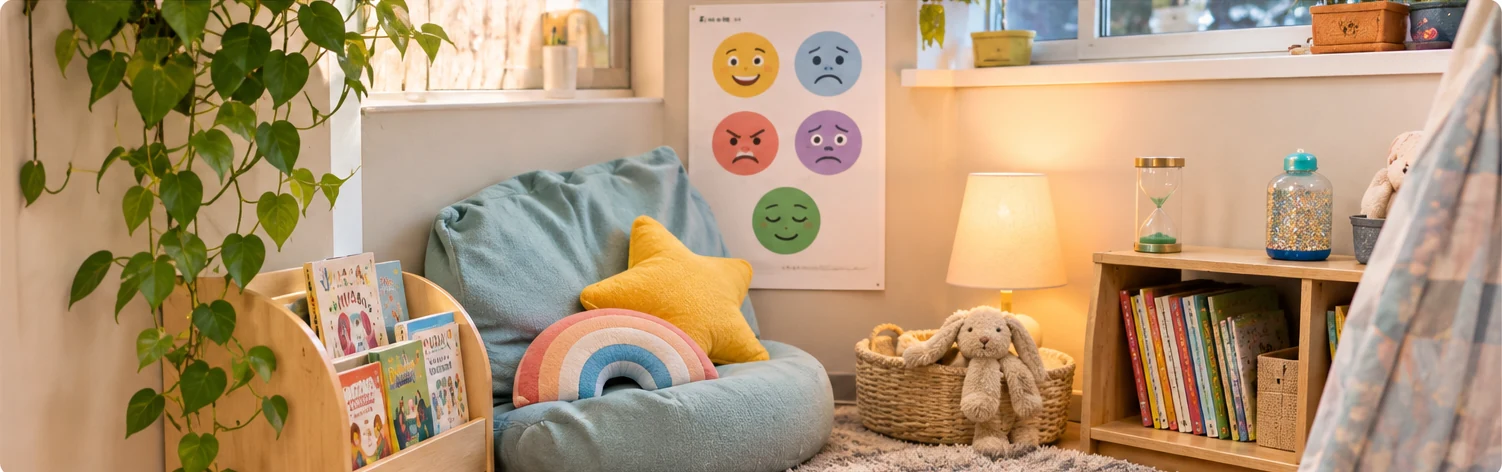
A calm corner is a supportive space where children can pause, receive adult support, and explore familiar regulation strategies.
It should never be used as punishment or an isolation area.
Your Calm Corner Essentials
Select an area away from unnecessary distractions, while maintaining appropriate adult supervision.
Use simple images representing familiar feelings such as happiness, sadness, anger, and calm.
Consider age-appropriate picture books, soft seating, drawing materials, or suitable sensory tools.
Introduce the calm corner before children need it during a difficult moment.
Provide appropriate adult support. Do not assume every child can regulate independently.
NAEYC describes educator-supported comfort spaces as one possible classroom strategy for helping children notice feelings and explore regulation tools.
The most important feature of a calm corner is not its decoration.
It's the supportive experience children have while using it.
The Mananas For Educators page explores how bilingual emotional learning tools can fit into calm corners, classroom routines, and early childhood programs.
Make Emotional Regulation Part of the Daily Routine
Emotional learning is more useful when children have repeated opportunities to practice skills throughout the day.
It does not require a long, separate lesson every morning.
Harvard University's Center on the Developing Child recommends play-based activities that give children opportunities to practice executive function and self-regulation skills.
Games, storytelling, pretend play, and movement activities can be adapted to children's developmental levels.
Supporting Emotional Regulation in Bilingual Classrooms
Children may express their emotions differently across languages.
A child might use Spanish at home and English at school, or alternate between the two naturally.
Teachers can support emotional communication by pairing simple words with accessible visuals and encouraging families to use their home languages.
"I can see this is difficult."
"Veo que esto es difícil."
"Would you like some help?"
"¿Quieres que te ayude?"
"Let's find a safe next step."
"Busquemos qué podemos hacer
de forma segura."
The purpose is not memorizing translations. It is helping children communicate in ways that are meaningful and accessible to them.
This approach aligns with the bilingual emphasis of The Mananas Method , which uses colors, symbols, and language as invitations for emotional exploration.
Adapt Emotional Regulation Activities for Different Needs
Not every child responds to the same calming strategy or visual support.
Developmental differences, sensory needs, disabilities, language differences, and previous experiences may shape how children communicate and regulate.
Consider these adjustments:
- Allow nonverbal responses such as pointing, gestures, or communication devices.
- Provide alternatives to activities involving touch or physical closeness.
- Offer movement-based options for children who find sitting quietly difficult.
- Adjust visual complexity and language demands.
- Coordinate with families and appropriate specialists when individualized support is needed.
When emotional distress is persistent, severe, or significantly affects daily functioning, educators should follow school procedures and collaborate with families and qualified professionals.
How Mananas Supports Emotional Learning in Early Childhood
At Mananas, we believe emotional learning can begin with small, meaningful interactions.
Our bilingual resources introduce emotions through accessible vocabulary, illustrations, colors, and creative activities.
These materials are designed to complement supportive adult-child interactions at home and in educational environments.
Start With Our Emotional Explorers
Free bilingual printables offer simple starting points for introducing feelings during classroom conversations and creative activities.
Happy Explorer
Sad Explorer
Calm Explorer
Explore The Mananas Studio for available creative activities.
Educators can also discover our current resources and learn about the developing classroom ecosystem through Mananas For Educators .
Small Classroom Moments Can Support Big Emotional Growth
Teaching emotional regulation in preschool does not mean expecting children to manage every difficult feeling independently.
It means creating a classroom where emotions can be recognized, expressed, and supported safely.
A morning check-in, a shared picture book, a pretend-play scenario, or a quiet moment with a trusted educator can create opportunities for meaningful practice.
Over time, children can develop a growing repertoire of words, relationships, and strategies for navigating emotions.
The goal isn't a classroom without big feelings. It's a classroom where children receive support while learning what to do with them.
Bring Bilingual Emotional Learning Into Your Classroom
Explore Mananas resources for emotional vocabulary, storytelling, creative activities, and meaningful classroom conversations.
Explore For Educators Discover Free ActivitiesResearch & Further Reading
- Collaborative for Academic, Social, and Emotional Learning (CASEL). CASEL's SEL Framework and Core Competencies. View source .
- National Association for the Education of Young Children (NAEYC). (2021). "How Are You Feeling?" Strategies for Helping Children Understand and Manage Emotions. View source .
- Center on the Developing Child at Harvard University. (2014). Enhancing and Practicing Executive Function Skills with Children from Infancy to Adolescence. View guide .
- Center on the Developing Child at Harvard University. (2022). Brain-Building Through Play: Activities for Infants, Toddlers, and Children. View resource .
Educational Note: This article provides general educational information. It is not intended as psychological assessment, diagnosis, or treatment. Mananas activities have not been clinically validated as therapeutic interventions. Educators should follow applicable school policies and seek qualified professional guidance when appropriate.




Review Teaching Emotional Regulation in Preschool: Practical Strategies for Educators.