
How Coloring and Creative Activities Help Children Express Their Emotions
Discover how drawing, colors, and playful creative experiences can open new ways for children to explore their feelings.
Imagine a child sitting quietly at a table, drawing a huge red shape across a piece of paper. A few minutes later, they add a tiny yellow sun.
You might be tempted to ask, "Are you angry?" or "Does the sun mean you're feeling better?"
But what if the red shape is a dragon? What if the yellow sun is simply their favorite thing to draw?
Children's artwork can offer opportunities for emotional expression, but its meaning belongs to the child—not the adult interpreting it.
Coloring, drawing, and open-ended creative activities can give children another way to explore their experiences when words are difficult to find.
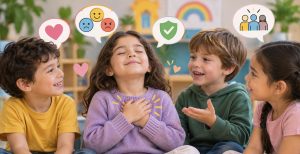
These activities can also create meaningful opportunities for parents and educators to listen, connect, and introduce emotional language.
Why Creative Activities Matter for Emotional Learning
Young children communicate in many ways. They use words, facial expressions, movement, play, gestures, and imagination.
Creative activities give children additional opportunities to make choices, experiment, represent ideas, and share experiences.
According to the National Association for the Education of Young Children (NAEYC) , open-ended artistic experiences can support language development, creative thinking, and aspects of social-emotional development.
Emotional expression doesn't always begin with words
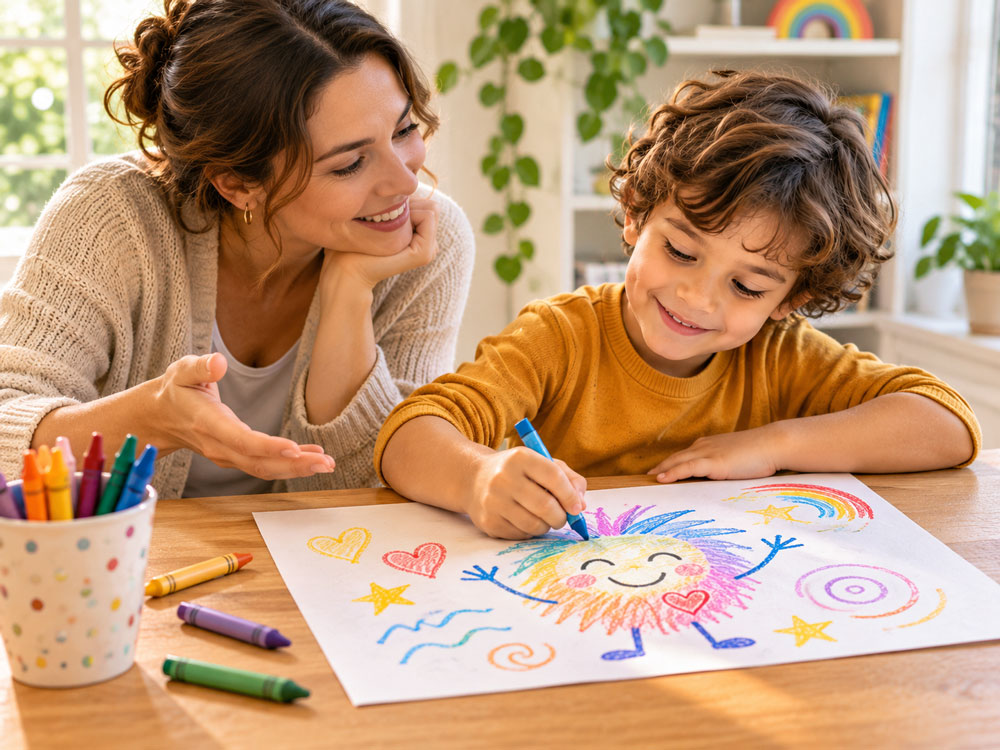
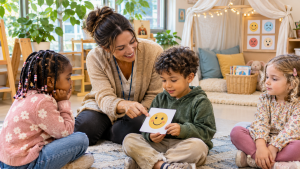
A child who struggles to explain a feeling may enjoy showing an adult a drawing, choosing colors, or making something with clay.
This creates an opportunity for a gentle conversation:
The child might explain a story, identify a feeling, or prefer not to talk. All of those responses are acceptable.
If your child is still learning to recognize and name feelings, our article Why Emotional Literacy Matters in Early Childhood explains the foundations of emotional vocabulary and supportive adult-child interaction.
Creativity also offers practice making choices
Children decide which materials to use, what to draw, when to change direction, and whether to start again.
These small decisions create opportunities for independence, flexibility, persistence, and self-expression.
The aim isn't to create a perfect picture. It's to allow a meaningful experience led by the child.
Can Drawing Help Children Manage Difficult Feelings?
Research suggests that drawing may help some children improve their short-term mood. But it's important to understand what the evidence actually shows.
Research Spotlight
In studies published in 2021, psychologist Jennifer Drake examined drawing and mood in children ages 6–12.
Drawing as an enjoyable distraction was associated with greater engagement and mood improvement compared with drawing specifically to express distress.
In other words, drawing something imaginative or enjoyable may sometimes be more helpful for short-term mood than asking a child to focus on an upsetting event.
Another study published in Cognitive Development in 2025 compared drawing with other activities among 150 children ages 7–8.
Mood improvements occurred after several types of engaging activities, not drawing alone. The findings suggest that creative activities can be useful, but drawing is not uniquely effective for every child.
These studies do not establish that ordinary coloring activities treat anxiety or other mental health conditions.
Emotional expression and emotional relief are different goals
Sometimes the purpose of an activity is to help a child communicate what they feel.
Other times, the child may benefit from a pleasant activity that shifts attention away from an upsetting situation.
Neither approach should be forced. Adults can offer choices and follow the child's response.
Process Art vs. Coloring Pages: Do Children Need Both?
Not all creative activities have the same purpose.
Process art focuses on exploration rather than producing a predetermined result. Children choose materials, experiment, and create freely.
Coloring pages provide more structure. They can offer familiar images, shared vocabulary, and an accessible starting point for conversation.
The child decides what to make, which colors to use, and what the artwork means.
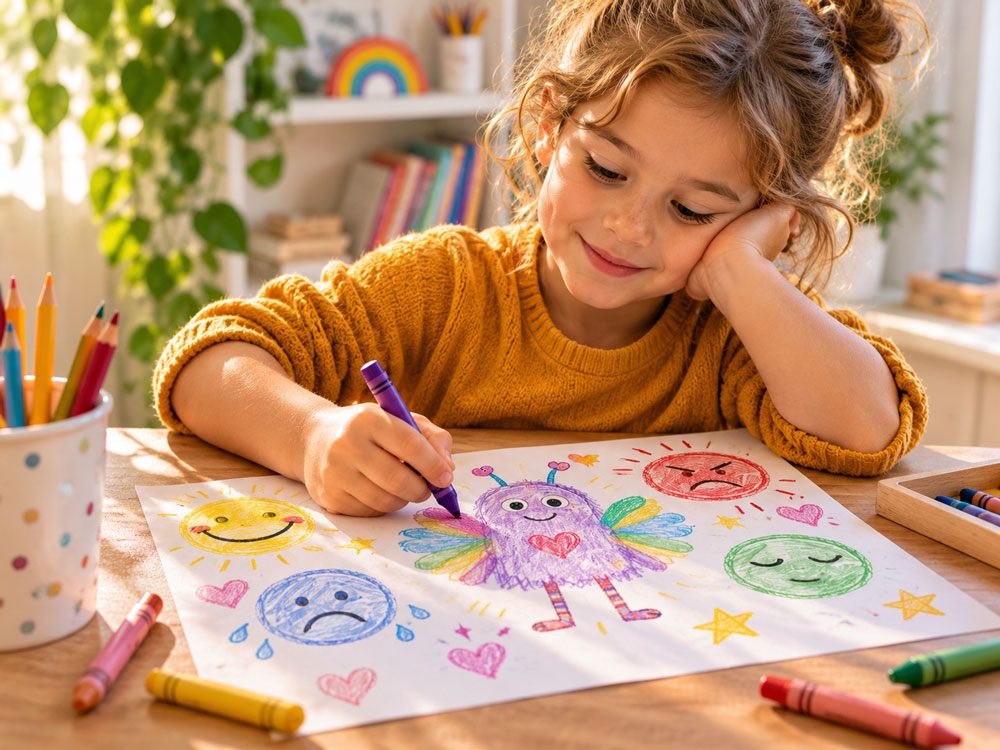
Example: drawing a feeling as an imaginary creature.
The child explores an image or a simple prompt with adult support.
Example: coloring a character from a story about sadness.
NAEYC emphasizes the rich learning opportunities of child-led, process-focused art experiences.
Structured activities can also be useful when they serve a clear educational purpose and allow children genuine choices.
At Mananas, we recommend using both approaches thoughtfully. A printable activity might introduce a feeling, followed by blank paper where children can express their own ideas.
Explore this approach through The Mananas Method , which connects emotional vocabulary with colors, symbols, conversation, and creative play.
5 Creative Emotional Activities for Kids Ages 3–8
These activities are designed to be simple, flexible, and adaptable to home or classroom settings.
No special artistic skills are needed. A small collection of crayons, paper, and a few minutes of shared attention can be enough.
1. If My Feeling Had a Color...
Invite your child to imagine their current feeling as a color, shape, or pattern.
Let the child decide. Happiness doesn't have to be yellow. Sadness doesn't have to be blue.
Adult tip: Ask what the color means to the child instead of assigning a meaning yourself.
2. Create a Feelings Character
Encourage your child to invent a character that experiences a particular emotion.
The character can have unusual colors, shapes, expressions, or superpowers.
Talking about a fictional character may feel easier than talking directly about personal experiences.
3. Color and Talk Together
Choose a simple picture representing happiness, sadness, or calm.
Color together and invite conversation about the emotion.
You can start with The Happy, Sad, or Calm Explorer , free bilingual printable activities available through The Mananas Studio.
Children may color, point, talk, or simply listen. Finishing the activity is not the main objective.
4. Draw a Place That Feels Comfortable
Invite your child to draw a real or imaginary place where they would like to spend time.
It could be a garden, a bedroom, an underwater world, or a magical treehouse.
This activity offers an imaginative focus without requiring children to revisit upsetting experiences.
5. Our Family Feelings Mural
Place a large sheet of paper on a table or wall.
Invite family members or classmates to contribute a color, drawing, word, or symbol representing something meaningful to them.
Encourage each participant to explain their contribution only if they want to.
The goal is shared creativity, listening, and connection— not creating identical pictures.
What to Say While Your Child Is Creating
The way adults respond can shape the experience. Instead of correcting or interpreting artwork, try open-ended observations.
Children should never be required to disclose private feelings simply because they are participating in an art activity.
If a child becomes distressed, pause the activity and offer appropriate support.
And remember: a drawing alone cannot reliably tell us whether a child has a psychological problem.
Bring Emotional Learning to Life with The Mananas Studio
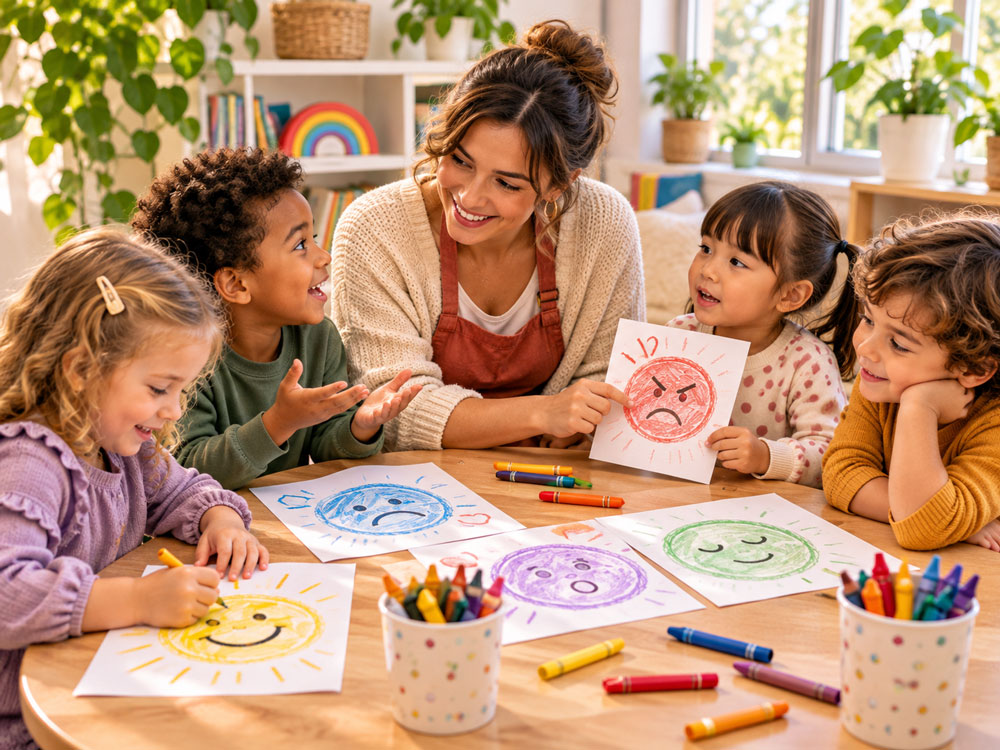
At Mananas, we use colors, symbols, and bilingual activities as starting points for meaningful conversations.
Our free Emotional Explorers are designed for children ages 3–8 and introduce familiar feelings through creative, screen-free activities.
Meet the Emotional Explorers
Choose a feeling and begin with a simple printable activity. Follow the child's lead.
Supporting Different Ages, Abilities, and Languages
Creative expression should be accessible to children with different communication, sensory, motor, and developmental needs.
Some children enjoy crayons. Others prefer painting, stickers, clay, digital drawing tools, or creating through movement.
Children can also participate by pointing, choosing colors, directing an adult, or describing what they imagine.
For bilingual families, use whichever language helps the child communicate comfortably.
"¿Qué color escogerías hoy?"
"Would you like to tell me about it?"
"¿Quieres contarme sobre tu dibujo?"
Educators looking for additional bilingual classroom materials can explore Mananas for Educators .
Is Coloring the Same as Art Therapy?
No. Coloring, drawing, and creative play can be valuable educational and recreational activities.
Art therapy is a mental health profession involving professional training, psychological theory, and a therapeutic relationship.
The American Art Therapy Association specifically distinguishes ordinary coloring activities from professional art therapy.
Mananas activities are educational resources for emotional exploration, not clinical treatment.
If a child shows persistent distress or significant changes in mood, behavior, or daily functioning, seek guidance from a qualified pediatric or mental health professional.
Every Color Can Begin a Conversation
Art doesn't have to be perfect to be meaningful.
A messy drawing, an imaginary character, or a page full of colors can become an opportunity for a child to explore ideas and connect with a caring adult.
Sometimes children will want to talk about feelings. Sometimes they'll simply enjoy creating something beautiful, funny, surprising, or entirely their own.
Both experiences have value.
The most important thing isn't the color they choose. It's the freedom to explore, create, and feel heard.
Little feelings. Colorful possibilities.
Explore free bilingual Emotional Explorers or discover our illustrated collection of emotional learning stories.
Explore Free Activities Discover The Rainbow of FeelingsResearch & Further Reading
- Drake, J. E. (2021). How Drawing to Distract Improves Mood in Children. Frontiers in Psychology. Read study .
- Brechet, C., Saget, C., & Vijil, I. (2025). From blank page to bright mind: Comparing the emotional benefits of drawing and other activities in children. Cognitive Development, 75, 101606. Read study .
- National Association for the Education of Young Children (NAEYC). Supporting the Development of Creativity. Read resource .
- Bongiorno, L. How Process-Focused Art Experiences Support Preschoolers. NAEYC. Read resource .
- American Art Therapy Association. About Art Therapy. Read resource .
Educational note: This article provides general educational information and does not constitute psychological assessment, diagnosis, or treatment. Mananas materials are not clinically validated therapeutic interventions.





Review How Coloring and Creative Activities Help Children Express Their Emotions.